
→ NEWSLETTER
→ @OPHELIADOSSANTOS
→ INFO@OPHELIADOSSANTOS.COM
ABOUT
Ophelia Dos Santos is a textile artist and researcher based in Cardiff, South Wales. Viewing the world through textiles, her practice explores local histories alongside themes of identity, migration and heritage. Through archival research and textile making, she examines Wales’ role within the British Empire and the complex relationship between the nation and the racially minoritized communities who call it home. She is particularly interested in how textiles carry personal and collective histories, connecting stories of labour, migration and cultural identity.
Working from her studio in Cardiff Bay – a place shaped by global trade, migration and the city’s multicultural docklands – Ophelia often reflects on her grandfather, who worked in the same space as a carpenter. Surrounded by his unfinished work, she considers legacy, the passing on of skills, and the influence of her Cabo Verdean heritage, creating an ongoing dialogue between past and present.

Drawn to the tactile and intimate qualities of textiles, Ophelia uses patchwork, embroidery and repurposed fabrics to explore memory, heritage and storytelling. Her portraits are loosely informed by archival and photographic references but are intentionally abstracted to evoke collective memory rather than specific individuals. By centring Black and racially minoritized figures, she reflects the histories, communities and identities that have long shaped Wales while challenging Eurocentric narratives of Welsh identity. Through textiles, Ophelia reimagines the nation’s past and expands contemporary understandings of who belongs within its story.
Alongside her artistic practice, Ophelia works across Wales’ heritage and cultural sector to broaden how the nation’s histories are researched, collected and shared. She is currently Curator of Black History at Amgueddfa Cymru – Museum Wales, where she develops collections and community-led projects that centre Black Welsh histories. Previously, she worked at Glamorgan Archives, supporting the delivery of the Research Guide for Ethnic Minority History in Glamorgan.
FILM
Producer and narrator of the short documentary film 'Moving to Make It'. This follows Ophelia’s dilemmas as a Welsh creative. BBC TWO Wales, It's My Shout Productions, 2021.
CONTRIBUTOR
Stories on the Edge of Memory: A book celebrating the Stories on the Edge of Memory project, including extracts from a series of interviews exploring the stories of Tiger Bay's - Wales' oldest multi-ethnic community. Images from the Tiger Bay and the World Archive, the People's Collection Wales and other sources. 2026.
KumbuKumbu: Kumbukumbu exists to celebrate, preserve, and share the rich histories and vibrant culture of Black Welsh communities. Through our comprehensive collections and community engagement, we ensure that these important stories are not only remembered but continue to inspire and educate future generations. 2026.
Decolonising Toolkit: Dismantling colonial structures in digital archives and collections. Peoples Collections Wales. 2025.
Research Guide to Sources for the Study of Minority Ethnic History in Glamorgan: This guide has been produced by Glamorgan Archives to support researchers of minority ethnic histories. It signposts researchers to collections of interest and methods of identifying previously unrecognised or underrepresented individuals and communities. 2024.
PRESS
Talking Heritage and Textile with BBC
Ophelia Dos Santos: Trafod treftadaeth mewn tecstiliau
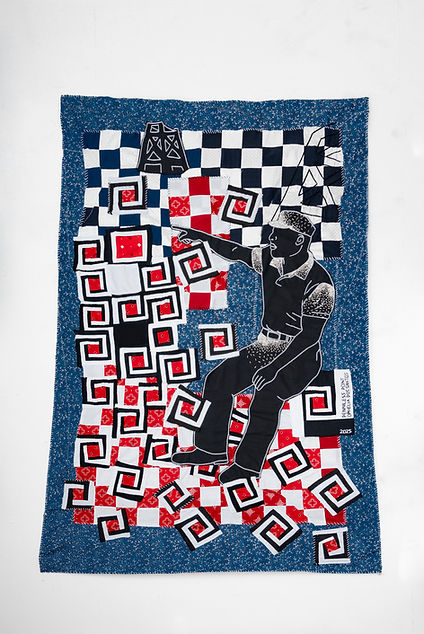
‘Penniless Point’ 200cm x 150cm, 2025.
Appliqué, hand embroidery, patchwork.
This textile work takes its title from the mythical “Penniless Point” of Tiger Bay, a place once described to the artist by her grandfather, a merchant seaman. The original Penniless Point, during the 1930s, stood on the corner of Bute Street and Bute Place. As Harry Cooke recalls, “the nickname was doubtless coined by some long gone wit, because it was the meeting place of out-of-work seamen who were looking for a berth, waiting for the pubs to open or just meeting old shipmates and friends.”.
Created in 2025, the piece reflects on the legacy of Penniless Point, a site the artist continues to pass most days. Though now largely absent from collective memory, it survives as a blue plaque opposite the Wales Millennium Centre—an understated marker of a once vital meeting place in Tiger Bay’s maritime history.

‘Saudade’ patchwork, 150cm x 150cm, 2025.
Acquired by Amgueddfa Cymru
@museumwales in 2025.
The Portuguese word ‘saudade’ reflects a profound longing for a beloved person or thing no longer present, a deep sense of nostalgia. It is a bittersweet emotion, balancing sadness and acceptance.
In the context of Cardiff Bay (including Butetown), saudade resonates with those who have witnessed the area’s physical and cultural transformations. For generations, diverse communities have coexisted here - Somali seafarers, West African traders, Maltese dockworkers, and Caribbean immigrants built homes, businesses, and families. However, since the 1960s, waves of redevelopment and displacement have reshaped the landscape, leaving many with a deep yearning for the community as it once was — the sights, sounds, and relationships that made it feel like home.

For Ophelia, hands and faces serve as direct representations of identity, heritage, and community. Through her work, she seeks to highlight the interconnectedness of personal and collective histories. The repeated motif of hands symbolises touch, care, and the passing down of knowledge, reflecting how skills, traditions, and cultural memory are preserved across generations.
This piece also challenges the traditional notions of Welsh identity. While the patchwork itself carries layered stories and histories, its pairing with the traditional Welsh hat — one of the most distinctive symbols of Welsh heritage, creates a striking visual contrast. The styling of the work and the photographic presentation function as two interwoven yet distinct narratives, challenging conventional perceptions of belonging and cultural representation in Wales.
Photography by Yusuf Ismail


‘Wasted on Us’ 93cm x 110cm, 2023.
Wasted on Us is a reflection on the social and environmental impacts of textile waste. This work explores the growing disconnect between land and people, questioning the consequences of mass consumption and disposal.
As Ophelia pieced together discarded fabrics, she considered their journeys — diverted from landfill, or perhaps destined for second-hand markets in Africa, where the West’s overconsumption fuels an overwhelming influx of textile waste. She reflected on the unknown makers, the forgotten hands that once stitched, wore, and cared for these fabrics before they arrived in her workshop. Repurposing these textiles became Ophelia reflected on labour, material value, and the hidden narratives embedded within cloth.
Wasted on Us highlights global majority perspectives by confronting the realities of fabric supply chains and waste processing. More than 150,000 tonnes of used clothing are imported to Ghana each year, much of it unsellable and left to pollute local environments. Through this work, Ophelia challenges the systems that enable this cycle of excess, displacement, and disregard.
Wasted on Us symbolizes resilience and interconnectedness. It asks the viewer to reconsider their relationship with fabric - not just as a material, but as a record of human history, labour, and environmental consequence. The patchwork stands as both a critique of modern consumption habits and a testament to the potential for transformation, repair, and renewed purpose in what has been cast aside.
Photography by Yusuf Ismail


‘We Touch Fabric Everyday' 29cm x 33cm, 2024.


‘Forgotten Hands’ 100cm x 105cm, 2024.


'Meaningful Change' 2024.


'A Warm Embrace' 2022.